


iSpring RCC7AK review
Updated 13 Nov 2026 · How we check
We earn a commission on some links. It never changes our picks. As an Amazon Associate we earn from qualifying purchases. How we earn money
The RCC7AK is the reverse osmosis system to buy on a budget, or for a sink with no outlet: a classic tank system with standard filters that cost about $70 a year, and an NSF listing for lead and fluoride on the version Amazon sells.
Skip it if: you mind the water it sends down the drain or the space it takes. The Waterdrop G3P800 wastes far less and leaves the cabinet free.
It is our best value pick in Best reverse osmosis systems.
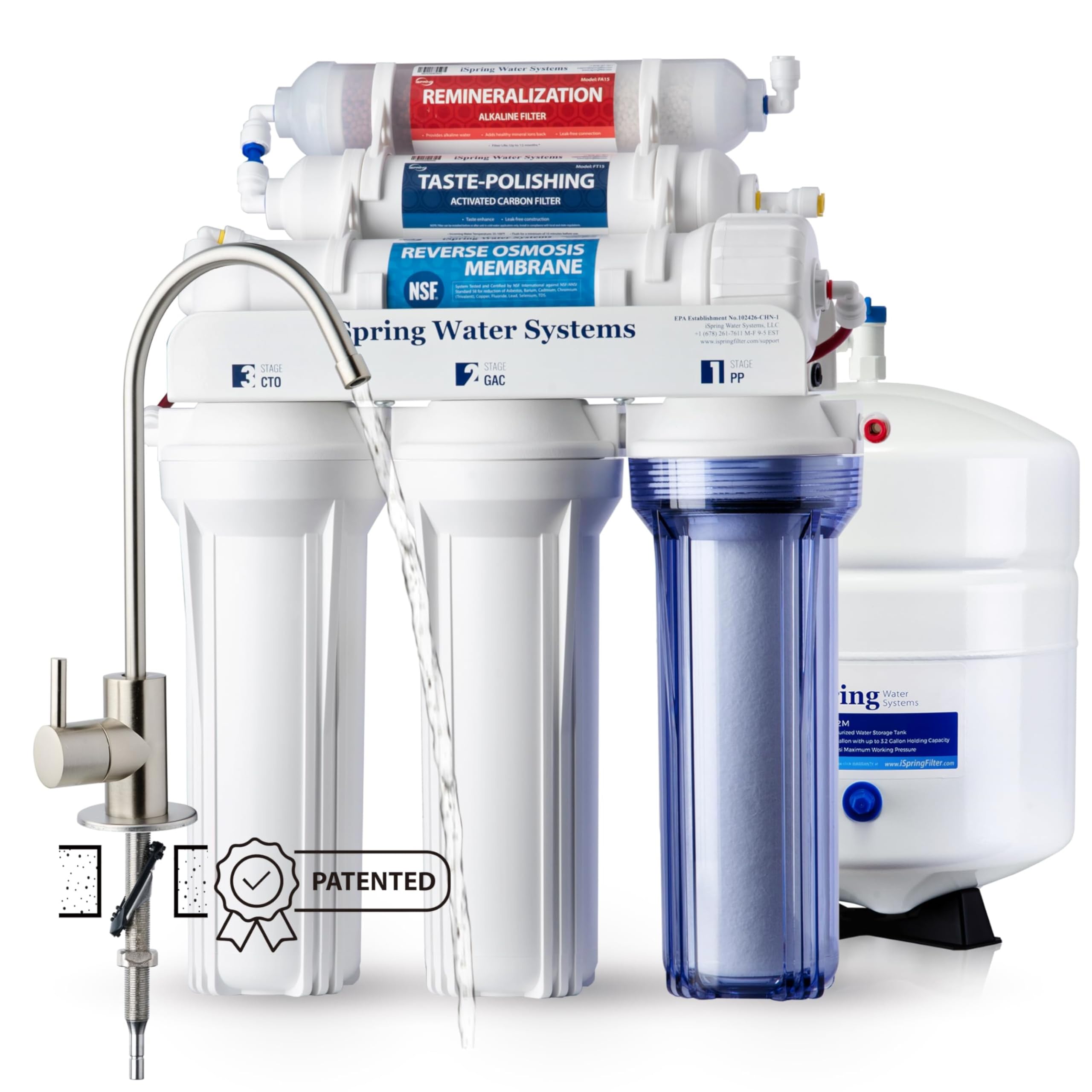
iSpring RCC7AK
A classic tank system at a low price, NSF certified for lead and fluoride, with standard filters anyone can buy.
- Makes
- 75 gal a day
- Type
- 3.2 gal tank
- Filter life
- Membrane 2 to 3 years
- List price
- $241.99
✓ Certified to NSF/ANSI 58 and 372, confirmed in the certifier’s listing. Output and filter figures are iSpring’s. List price and specs from ispringfilter.com, checked 13 Nov 2026. Amazon’s price may differ.
What we like and what we do not
- NSF certified for lead, fluoride, barium and other metals (BN and BLK versions)
- Standard 10-inch filters, about $70 a year
- No power needed
- Adds calcium and magnesium back in its last stage
- Sends about five gallons to the drain for each gallon made, by iSpring’s data sheet
- Tank and housings fill the cabinet
- Slower than a tank-free system once the tank is empty
- Two NSF listings with different claims, so check the model number
The facts
| Certification | ✓ Certified by NSF for the RCC7AK-BN and RCC7AK-BLK to NSF/ANSI 58 (asbestos, barium, cadmium, chromium 3, copper, fluoride, lead, selenium, dissolved solids) and to 372. NSF lists the plain RCC7AK, from another factory, for dissolved solids only | NSF listing, read 13 Nov 2026 |
|---|---|---|
| Stages | Six: sediment, granular carbon, carbon block, RO membrane, post carbon, alkaline remineralization | iSpring product page, 13 Nov 2026 |
| Certified reductions (BN and BLK) | Asbestos, barium, cadmium, chromium 3, copper, fluoride, lead, selenium and dissolved solids | NSF listing, 13 Nov 2026 |
| Not claimed in the listing | Arsenic, nitrate, PFAS, bacteria and viruses | NSF listing, 13 Nov 2026 |
| Output | Rated 75 gallons a day; NSF’s test recorded 25.41 gallons a day under its standard conditions | NSF listing, 13 Nov 2026 |
| Efficiency | About 16%, which is roughly five gallons to drain for each gallon made | iSpring data sheet, 13 Nov 2026 |
| Water pressure | 40 to 80 psi | iSpring data sheet, 13 Nov 2026 |
| Tank | 3.2 gallons | Amazon product details, 13 Nov 2026 |
| Size | 15.5 x 16 x 18 in, 20 lb | Amazon product details, 13 Nov 2026 |
| Power | None needed | iSpring product page, 13 Nov 2026 |
| List price | $241.99 | ispringfilter.com, 13 Nov 2026 |
| Replacement filters | F19K75 two-year set with membrane, $139.99 list at Home Depot | Home Depot, 13 Nov 2026 |
Every fact shows where it came from and the date. Removal, life and flow figures are the maker’s unless the row says otherwise. We have not tested this filter ourselves.
What is in the box
The kit is a bracket with six housings and the membrane, a 3.2-gallon pressure tank, a faucet that mounts from above the counter, a feed water adapter, a drain saddle and tubing. It needs no power.
Its filters are the common 10 by 2.5 inch size, so iSpring’s own sets and many others fit. iSpring sells one-year, two-year and three-year sets. (iSpring filter set page, 13 Nov 2026)
Installation and first use
- Check the pressure. iSpring’s data sheet gives 40 to 80 psi. Below that, the tank fills slowly; iSpring sells pumped versions for low pressure.
- Fit the feed adapter to the cold line and the drain saddle above the trap.
- Mount the faucet. iSpring’s top-mounted design lets you tighten it from above the counter.
- Set the tank and connect the tubes, then open the feed and check for leaks.
- Fill and empty the tank before drinking, as the manual describes. It takes a few hours.
Output, pressure and water to drain
A tank system makes water slowly and stores it. iSpring rates the membrane at 75 gallons a day; under NSF’s standard test conditions it made 25.41 gallons a day. In a kitchen that means a full tank at breakfast and a slower trickle once you have drawn it down. (NSF listing, 13 Nov 2026)
The bigger cost is water. iSpring’s data sheet gives an efficiency of about 16%, roughly five gallons to the drain for each gallon kept. That matters on a metered supply or a septic system. (iSpring data sheet, 13 Nov 2026)
Low water pressure makes both worse, which is why iSpring publishes a pressure range.
Filter changes and care
Changing filters
Shut off the feed, release pressure at the faucet, unscrew the housings with the wrench and swap the cartridges. iSpring says the membrane lasts two to three years; the pre-filters are changed more often, and its two-year set covers both. (iSpring data sheet, 13 Nov 2026; iSpring filter set page, 13 Nov 2026)
The tank
If water flow from the faucet drops but the filters are fresh, the tank’s air charge may be low. The manual explains how to check it.
Who it suits, and who should pick something else
Tight budgets. It costs a fraction of the tank-free picks and is cheap to run.
Sinks with no outlet, or households that want water during a power cut.
DIY installers who like standard parts they can buy anywhere.
Pick something else if water waste or cabinet space matters (the Waterdrop G3P800), or your water has arsenic or radium (the APEC RO-90).
How it compares with our other picks
Against the APEC RO-90: both are tank systems with standard filters and similar yearly costs. The APEC adds certified arsenic, chromium 6 and radium and has longer-rated filters; the iSpring is cheaper and adds an alkaline stage.
Against the Waterdrop G3P800: the Waterdrop is faster, smaller and wastes far less water, and is certified for PFOA/PFOS, but it costs about three times as much and needs power.
A tank system with the widest certified list, arsenic and radium included. List price $264.99 at apecwater.com, checked 13 Nov 2026. Read our RO-90 review
Tank-free, fast and water-efficient. List price $849.00 at waterdropfilter.com, checked 13 Nov 2026. Read our G3P800 review
No installation at all. List price $375.00 at aquatru.com, checked 13 Nov 2026. Read our Carafe review
All five are side by side in Best reverse osmosis systems.
Size and running cost
We drew the RCC7AK with its tank next to a 12 oz drink can, from the dimensions in its listing. Then we added up its filters.
| A year of filters at list prices | $70.00: half of the F19K75 two-year set, membrane included ($139.99) | Home Depot list price, 13 Nov 2026 |
|---|---|---|
| Maker’s schedule | Pre-filters within the year; membrane every 2 to 3 years | iSpring data sheet, 13 Nov 2026 |
| Water to drain per gallon made | About 5 gallons (16% efficiency) | Our arithmetic from iSpring’s data sheet |
The last two rows are our own arithmetic from the list price and the maker’s rating, not a measurement. Real filter life depends on how dirty the water is and how the filter is cleaned and stored.
Common questions
Is the RCC7AK NSF certified?
Yes, but check the version. NSF lists the RCC7AK-BN and RCC7AK-BLK for lead, fluoride and other metals, and a plain RCC7AK for dissolved solids only. (NSF listing, 13 Nov 2026)
Does it remove fluoride?
The BN and BLK versions are certified for fluoride reduction under NSF/ANSI 58. (NSF listing, 13 Nov 2026)
Does it need electricity?
No. Household water pressure drives it.
Can I use other brands' filters?
It takes standard 10 by 2.5 inch cartridges, so many fit, but the certification covers iSpring’s own modules.
How we check
We research each product in depth: the maker’s specifications, manual and care instructions, the NSF, WQA and IAPMO certification listings, published independent field and lab tests, and what buyers report. We do not run a lab of our own, and we have not tested this filter ourselves. When a claim has no certification behind it, we say whose claim it is. More on how we check.
Sources
Makers, certifiers, public health bodies and retailers’ specification pages. A date after a link is the page’s own date where it has one. Otherwise it is the day we read it, 13 Nov 2026.
- NSF, listing for iSpring Water Systems, 13 Nov 2026
- iSpring, RCC7AK 6-stage reverse osmosis system product page, 13 Nov 2026
- iSpring, RCC7AK user manual and performance data sheet, 13 Nov 2026
- iSpring, F19K75 2-year filter set product page, 13 Nov 2026
- Home Depot, iSpring F19K75 2-year filter set product page, 13 Nov 2026