

Katadyn BeFree AC review
Updated 12 Nov 2026 · How we check
We earn a commission on some links. It never changes our picks. As an Amazon Associate we earn from qualifying purchases. How we earn money
The Katadyn BeFree AC is the filter to buy if you want the lightest soft bottle with a filter in the cap. It is a 1 liter flask that weighs 2.7 oz, flows fast, cleans with a shake, and adds a small carbon stage for the taste of chlorinated tap water.
Skip it if: your water is often silty, or you want to use ordinary bottles. Fine sediment clogs it quickly, and its 42 mm thread does not fit them. The Sawyer Squeeze and the Platypus QuickDraw both fit 28 mm bottles.
It is the lightest soft bottle in Best water filter straws. The BeFree AC replaces the earlier BeFree 1.0L, which Katadyn has withdrawn.
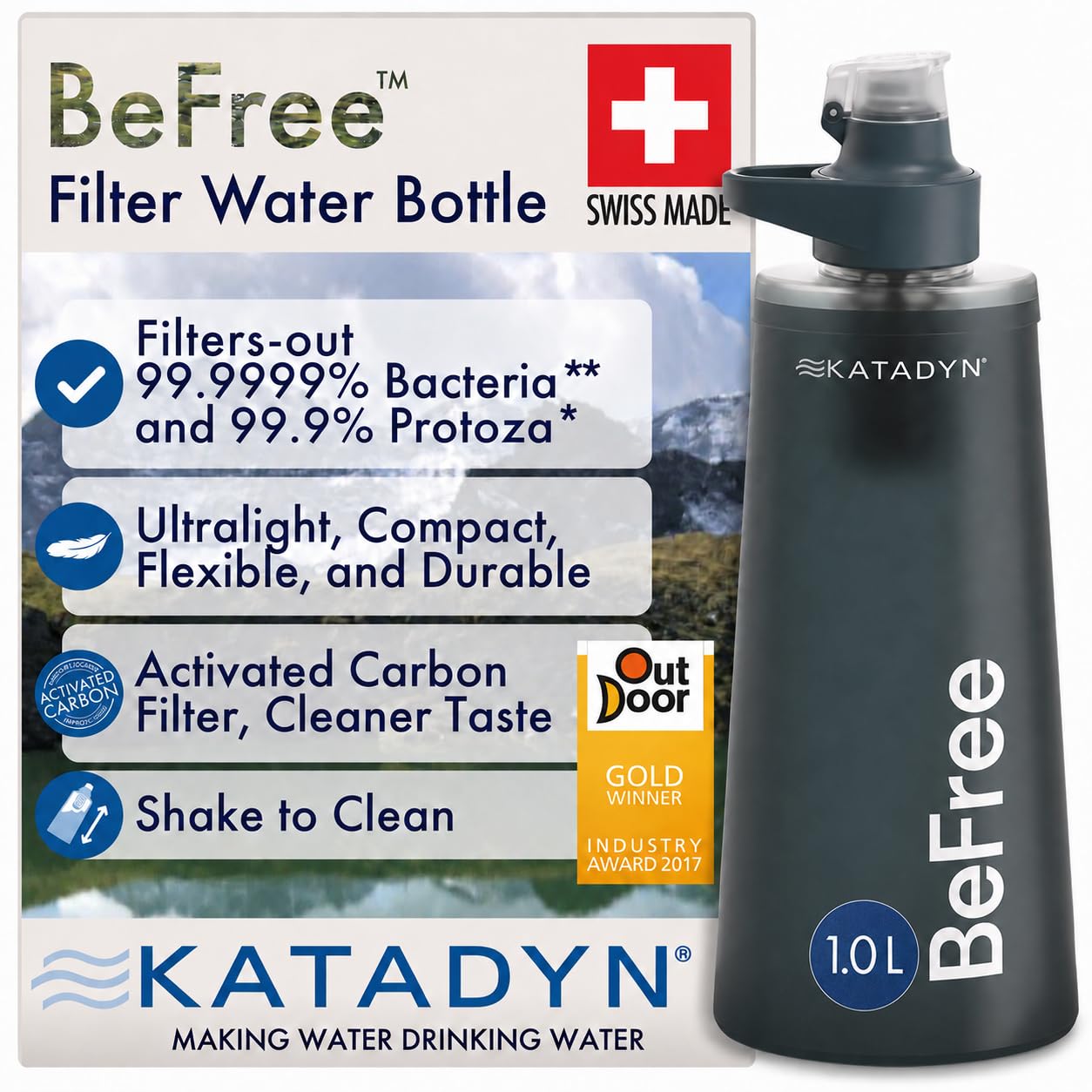
Katadyn BeFree AC 1.0L
A 1-liter soft bottle with the filter in the cap: fill, squeeze and drink, and clean it by shaking.
- Filter life
- Up to 264 gal (1,000 L)
- Weight
- 2.7 oz
- Pore size
- 0.1 micron
- List price
- $52.95
No third-party certification found in the NSF, WQA or IAPMO listings. Capacity and flow figures are Katadyn’s. Specs from Katadyn's fact sheet, list price from REI, checked 12 Nov 2026. Amazon’s price may differ.
What we like and what we do not
- The lightest soft bottle in our guide, at 2.7 oz with the flask
- A liter in about 25 seconds in independent timing
- Cleans by shaking or swishing, with no syringe or tools
- Removable carbon stage for taste and chlorine
- No third-party certification found
- Rated for 1,000 liters, and the carbon for 200
- Fine sediment clogs it quickly, in independent tests
- Its 42 mm thread does not fit ordinary drink bottles
The facts
| Certification | None found in the NSF, WQA or IAPMO listings | NSF, WQA and IAPMO listings, searched 12 Nov 2026 |
|---|---|---|
| Filter type | Stage 1: hollow fiber, 0.1 micron. Stage 2: replaceable activated carbon | Katadyn fact sheet, dated 9 Oct 2025 |
| Maker says it removes | Bacteria, protozoa and microplastics. The carbon improves taste and reduces odor, turbidity and chlorine | Katadyn fact sheet, dated 9 Oct 2025 |
| Tested for | 99.9999% reduction of bacteria and 99.9% of protozoan cysts, according to Katadyn’s manual | Katadyn manual, 12 Nov 2026 |
| Does not remove | Viruses. For fresh water only, not salt or brackish water | Katadyn manual, 12 Nov 2026 |
| Rated life | Hollow fiber filter up to 1,000 liters (264 gallons). Carbon up to 200 liters, or three months from first use | Katadyn manual, 12 Nov 2026 |
| Flow | Up to 2 liters a minute. About 25 seconds per liter in one independent test | Katadyn fact sheet, dated 9 Oct 2025 |
| Weight | 76 g (2.7 oz) | Katadyn fact sheet, dated 9 Oct 2025 |
| Size | 273 x 107 x 78 mm (10.7 x 4.2 x 3.1 in) | Katadyn fact sheet, dated 9 Oct 2025 |
| Flask | 1.0 liter HydraPak SoftFlask in TPU, free of PVC and BPA, with a 42 mm thread | Katadyn fact sheet, dated 9 Oct 2025 |
| List price | $52.95 | REI, 12 Nov 2026 |
Every fact shows where it came from and the date. Removal, life and flow figures are the maker’s unless the row says otherwise. We have not tested this filter ourselves.
What is in the box
The BeFree AC arrives as one assembled piece: a 1 liter soft flask with the filter screwed into its neck. Katadyn’s manual names the parts as the silicone mouthpiece, the flip cap, the activated carbon fibers and their holder, the hollow fiber filter, which Katadyn calls the EZ-Clean Membrane, and the SoftFlask. (Katadyn manual, 12 Nov 2026)
What is new in the AC model is the carbon stage, a small pad that sits in a holder between the filter and the cap, and a redesigned cap with a sturdy handle for carrying or clipping to a pack. The mouthpiece pulls off for cleaning. The carbon and the filter can both be replaced separately. (Katadyn fact sheet, dated 9 Oct 2025)
The BeFree AC is also sold with a 0.5 liter flask. Retailers now list the 1.0 liter version with a double-layer flask. This review covers the 1.0 liter version.
Setup and first use
- Flush it. Before the first use, filter a liter of water and pour it away. (Katadyn manual, 12 Nov 2026)
- Decide whether to fit the carbon. Unscrew the flip cap from the filter, place the carbon pad in its holder and screw the cap back on. After fitting a new carbon pad, flush another liter to rinse out harmless carbon dust.
- Fill the flask with fresh water, holding it by the rigid collar, and wipe the outside.
- Screw the filter in until it seats. Katadyn warns that a cross-threaded cap can let water bypass the filter or leak.
- Open the flip cap and drink or squeeze. Turning the flask upside down and squeezing lightly gives the best flow.
The carbon is for taste, not safety. Katadyn says it improves taste and reduces odor and chlorine, and also that it restricts the flow. Leave it out at a clear mountain stream and fit it for treated tap water or water that smells. (Katadyn manual, 12 Nov 2026; REI product page, 12 Nov 2026)
Flow and clogging
Katadyn claims up to 2 liters a minute. (Katadyn fact sheet, dated 9 Oct 2025)
Independent tests support the claim. One current test lists a liter in about 25 seconds, the quickest of the filters in our guide, and describes the flow as great. Another puts a fresh filter at a minute or less per liter in normal use.
The price of that speed is sensitivity to dirt. Testers report that fine debris clogs the membrane quickly, and Katadyn’s manual tells owners to use the clearest water available and to avoid still water. Buyers on REI’s page say the same: flow drops as sediment builds, and comes back when the filter is cleaned. Several add that the carbon pad slows it. (Katadyn manual, 12 Nov 2026; REI product page, 12 Nov 2026)
On durability, testers rank the flask below thicker soft bottles such as the LifeStraw Peak Series Squeeze, and testers of earlier BeFree versions reported pinhole leaks in the flask. The filter can be moved to another 42 mm soft flask if the original fails.
Cleaning and storage
Cleaning in the field
Katadyn gives two methods and asks for one of them at least every 5 liters when the flow slows. Shake: fill the flask with clean water, close it and shake. Swish: unscrew the filter and swish it in clean water, keeping the mouthpiece end out of untreated water. (Katadyn manual, 12 Nov 2026)
Three things the manual says not to do: do not rinse the filter under a running tap, which can break the fibers, do not touch the fibers with fingers or tools, and do not let the filter freeze.
If the flow is still poor, for example after storage, soak the whole system in water for at least an hour. If shaking and swishing no longer help, the filter is finished.
Disinfecting and storage
Katadyn’s routine, to be done monthly, every 100 liters or before storage: take out the carbon, add one Micropur tablet or four drops of unscented household bleach to filtered water, pour it into the flask, squeeze all of it through the filter, then let every part air dry completely before putting it back together. After storage, flush with a liter of clean water. (Katadyn manual, 12 Nov 2026)
Drops
After a hard drop, the manual directs owners to a filter integrity test on Katadyn’s website. A filter that is damaged should not be used. (Katadyn manual, 12 Nov 2026)
Who it suits, and who should pick something else
Trail runners, day hikers and ultralight backpackers drinking from clear streams. Scoop, drink, go.
Travelers who dislike the taste of chlorinated tap water. The carbon stage is there for that. It does not make unsafe tap water safe from viruses.
People who will not carry a syringe. No other cleaning method here is simpler.
Pick something else if your sources are silty or glacial (a filter you can backflush hard, such as the Sawyer Squeeze), if you want a tougher bottle (the LifeStraw Peak Series Squeeze), or if you want to use standard bottles (the Platypus QuickDraw).
It does not remove viruses. The CDC says a filter with pores of 0.3 micron or smaller removes bacteria and parasites but not viruses, and advises filtering first and then disinfecting where viruses are a risk. (CDC, reviewed 30 Jan 2025)
How it compares with our other picks
Against the LifeStraw Peak Series Squeeze: the BeFree is more than an ounce lighter, a little faster in testing, and cleans without a syringe. The LifeStraw has the thicker bottle, twice the life rating and a lower list price.
Against the Platypus QuickDraw: the same 1,000 liter rating and a similar price. The BeFree is lighter and has carbon. The QuickDraw fits standard bottles and can be checked for damage on the trail.
Against the Sawyer Squeeze: the Sawyer is slower, has more parts, and will outlast the BeFree many times over for less money.
A thicker 1 liter bottle and a filter rated for 2,000 liters, cleaned with a syringe. List price $43.95 at lifestraw.com, checked 12 Nov 2026. Read our Peak Series Squeeze review
Fits 28 mm bottles and has a field check for freeze or drop damage. List price $54.95 at REI, checked 12 Nov 2026. Read our QuickDraw review
A separate 3 oz filter rated for 100,000 gallons, with two pouches. List price $45.99 at sawyer.com, checked 12 Nov 2026. Read our Sawyer Squeeze review
All nine filters are side by side in Best water filter straws.
Size and running cost
We drew the BeFree AC full, at the size Katadyn gives for it, next to a 12 oz drink can and the LifeStraw Peak Series Squeeze. Then we worked out the running cost, including the carbon.
| List price | $52.95 | REI, 12 Nov 2026 |
|---|---|---|
| Maker’s rated life | Up to 1,000 liters (264 gallons). Carbon up to 200 liters | Katadyn fact sheet, dated 9 Oct 2025 |
| Cost per 1,000 liters (264 gallons) of rated life | about $52.95 | Our arithmetic |
| Water for one person at 4 liters (about a gallon) a day | about 250 days | Our arithmetic |
The last two rows are our own arithmetic from the list price and the maker’s rating, not a measurement. Real filter life depends on how dirty the water is and how the filter is cleaned and stored.
Common questions
What is the difference between the BeFree and the BeFree AC?
The AC adds a replaceable activated carbon stage for taste, odor and chlorine, and a new flip cap with a carry handle. The hollow fiber filter is the same 0.1 micron type, rated for up to 1,000 liters. Katadyn has withdrawn the earlier BeFree 1.0L in favor of the AC. (Katadyn fact sheet, dated 9 Oct 2025)
Does the BeFree AC remove viruses?
No. Katadyn’s manual says the BeFree does not remove viruses and recommends a disinfectant or boiling where they are a risk. (Katadyn manual, 12 Nov 2026)
Do I have to use the carbon?
No. Katadyn says the bottle can be used without it, and that the carbon restricts flow. Use it when taste or chlorine is the problem. (Katadyn manual, 12 Nov 2026)
How often does the carbon need replacing?
After 200 liters or three months from first use, according to the manual. The hollow fiber filter is rated for up to 1,000 liters. (Katadyn manual, 12 Nov 2026)
Will the filter fit a regular water bottle?
No. It has a 42 mm thread, made for HydraPak-style soft flasks. (Katadyn fact sheet, dated 9 Oct 2025)
Is the BeFree AC NSF certified?
We searched the NSF, WQA and IAPMO listings on 12 Nov 2026 and did not find the BeFree. Katadyn’s manual says it is tested to US EPA standards for bacteria and cysts. That is the maker’s claim, not a certifier’s listing. (Katadyn manual, 12 Nov 2026)
How we check
We research each product in depth: the maker’s specifications, manual and care instructions, the NSF, WQA and IAPMO certification listings, published independent field and lab tests, and what buyers report. We do not run a lab of our own, and we have not tested this filter ourselves. When a claim has no certification behind it, we say whose claim it is. More on how we check.
Sources
Makers, certifiers, public health bodies and retailers’ specification pages. A date after a link is the page’s own date where it has one. Otherwise it is the day we read it, 12 Nov 2026.
- LifeStraw, Peak Series squeeze bottle 1 L product page, 12 Nov 2026
- Katadyn, BeFree Filter AC 1.0L fact sheet (retailer copy), dated 9 Oct 2025
- Katadyn, BeFree AC manual, print no. 8021506/1 (retailer copy), 12 Nov 2026
- REI, Katadyn BeFree AC 1.0 L product page, 12 Nov 2026
- CDC, Water treatment options when hiking, camping, or traveling, reviewed 30 Jan 2025
- NSF, certified drinking water treatment units listing, 12 Nov 2026
- WQA, certified product listings, 12 Nov 2026
- IAPMO R&T, product listing directory, 12 Nov 2026