

Best gravity water filters
Updated 12 Nov 2026 · How we check
We earn a commission on some links. It never changes our picks. As an Amazon Associate we earn from qualifying purchases. How we earn money
For the home, the Culligan MaxClear Scout is our top pick. It is the one countertop gravity system here certified to reduce lead, PFAS and chlorine.
Longest filter life: the British Berkefeld, whose cleanable ceramic elements are rated for 400 gallons each.
For camping and emergencies: the Platypus GravityWorks for groups, the MSR AutoFlow XL for the biggest bag, and the LifeStraw Gravity Purifier if you need to remove viruses.
The MaxClear is the only pick certified as sold here. The countertop systems are for tap water that is already safe; the camp bags are for outdoor water.
The picks side by side
| Product | Certified for | List price | Filter life | Holds | Best for |
|---|---|---|---|---|---|
Top pick Culligan MaxClear Scout | NSF/ANSI 42, 53, 401 and 372 | $175.00 | 50 gal per filter, up to 6 months | 2.25 gal | City water: lead, PFAS, chlorine |
Longest filter life British Berkefeld 12 L | None found | $330.00 | 400 gal per element, or 6 months | 3 gal | Low running cost, cleanable ceramic |
Best for camping groups Platypus GravityWorks | None found | $134.95 | Up to 1,500 L | 4 L plus 4 L clean | Camping groups |
Largest bag MSR AutoFlow XL | None found | $139.95 | Up to 1,500 L | 10 L | Base camps and families |
Removes viruses LifeStraw Gravity Purifier | None found | $189.95 | Up to 18,000 L | 8 L | Travel and emergencies: viruses |
List prices are from the maker, or from the retailer named in each product’s box, checked 12 Nov 2026. Amazon’s price can differ, so the button shows you today’s. A certification is listed only when we found it in the certifier’s own listing for that model. Filter life is each maker’s rating. “Holds” is the water one fill gives you.
Our picks in detail
Each product is here for a stated reason, shown in the label above its name. The first two are countertop systems for the kitchen. The last three are gravity bags for camping, cabins and emergency kits, which treat outdoor water and pack small.
Countertop systems for the home
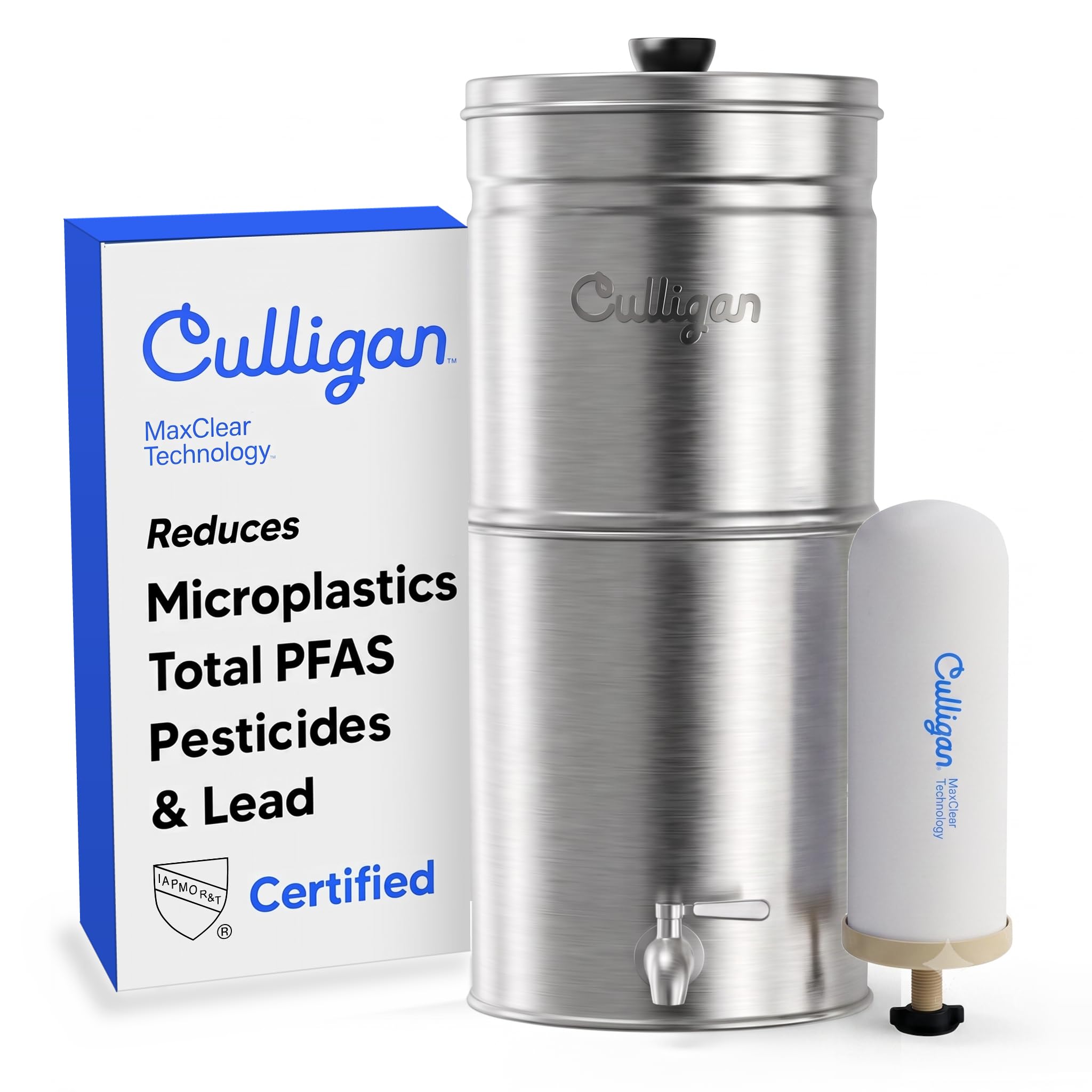
Culligan MaxClear Scout
A stainless steel gravity system certified to reduce lead, PFAS and chlorine, the claims most homes buy a filter for.
- Holds
- 2.25 gal
- Filter life
- 50 gal per filter, up to 6 months
- Flow
- 4 gal a day
- List price
- $175.00
✓ Certified to NSF/ANSI 42, 53, 401 and 372, confirmed in the certifier’s listing. Reduction and capacity figures are from the IAPMO listing. List price and specs from shop.culligan.com, checked 12 Nov 2026. Amazon’s price may differ.
The Scout is the system to buy if you are on city water and your worry is what the supply carries to your tap: lead from old pipes, PFAS, the taste of chlorine. IAPMO R&T, an accredited certifier that tests to the same NSF/ANSI standards as NSF, lists its MaxClear filter under NSF/ANSI 53 for lead and total PFAS, under 42 for chlorine and chloramine, and under 401 for microplastics and seven trace chemicals. No other system in this guide shows those claims in a certifier’s listing. (IAPMO listing)
It is a classic two-chamber steel unit. You pour tap water into the top, it drips through a ceramic and carbon filter into the bottom, and a spigot draws it off. The Scout holds 2.25 gallons, takes up to two filters, and Culligan sizes it for one to three people. The filter needs no priming and may dry out between uses, which is not true of most gravity filters.
The catch is filter life. Each filter is certified for 50 gallons at about 4 gallons a day, and Culligan says to replace it within six months. At $69 a filter that is far dearer per gallon than the ceramic elements in the British Berkefeld below. Culligan also says to use it on drinking water that is already safe, not on water of unknown quality. A bigger household can look at the 3-gallon Venture, which takes up to three of the same filters. (Culligan data sheet)
- Certified for lead, total PFAS, chlorine and microplastics
- No priming, and the filter may dry out between uses
- Five-year warranty on the stainless housing
- Each filter is rated for only 50 gallons
- Slow: certified at about 4 gallons a day
- For treated tap water, not water of unknown quality
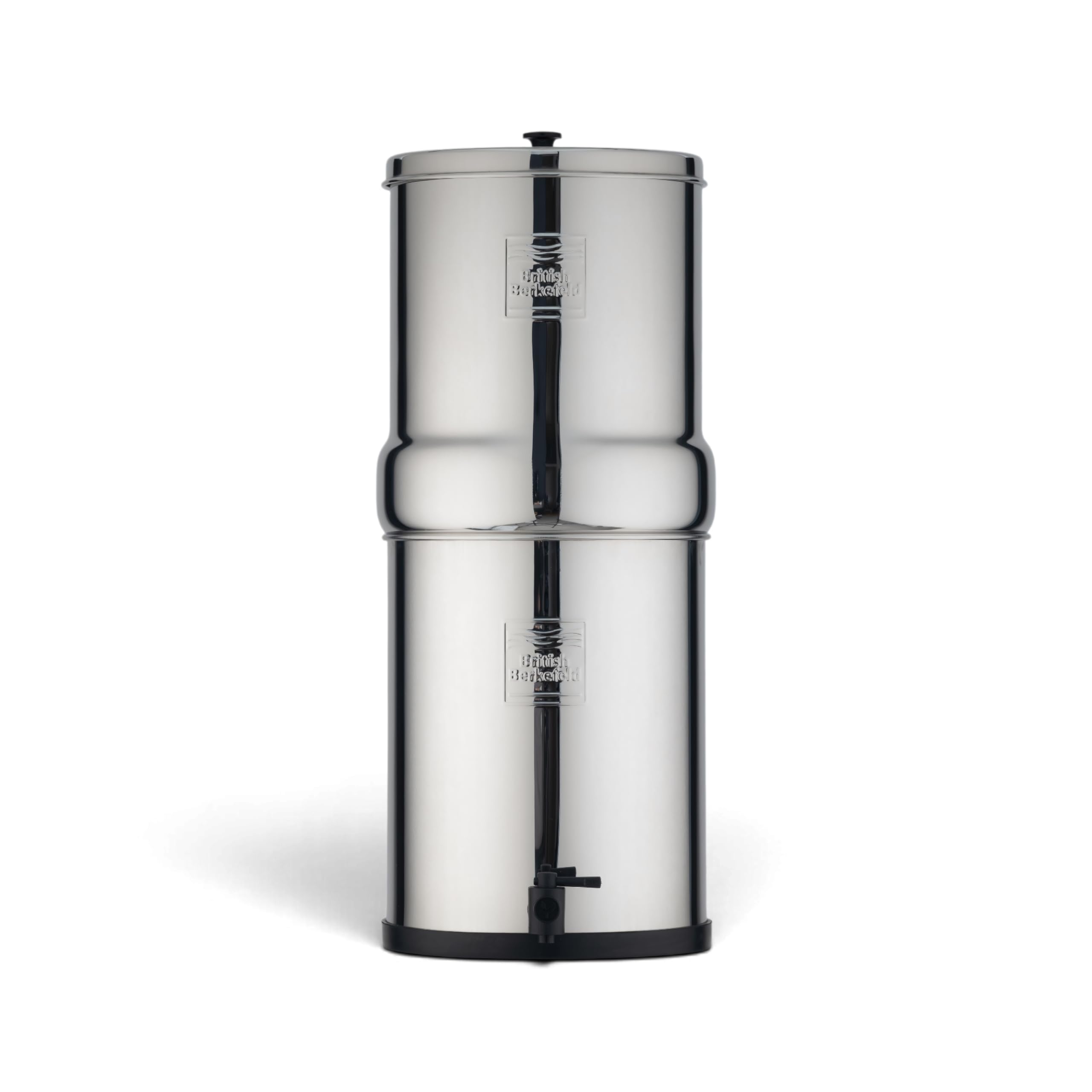
British Berkefeld 12 L
Cleanable ceramic elements rated for 400 gallons each, eight times the life of a MaxClear filter, in a 3-gallon stainless system.
- Holds
- 3 gal
- Filter life
- 400 gal per element, or 6 months
- Flow
- 0.29 gal an hour per element
- List price
- $330.00
No third-party certification found in the NSF, WQA or IAPMO listings. Life and flow figures are British Berkefeld's, as listed by Lehman's. List price and specs from Lehman's, checked 12 Nov 2026. Amazon’s price may differ.
The reason to buy a British Berkefeld is its Ultra Sterasyl element. Each one is rated for 400 gallons or six months, and when the flow drops you scrub the ceramic with a kitchen pad and put it back. Two elements cost about as much as one and a quarter MaxClear filters and are rated for sixteen times as much water. (Lehman's)
The certification needs a careful reading. NSF lists the 8.5-liter British Berkefeld SS2 system with Ultra Sterasyl elements under NSF/ANSI 42 for fine particles, 53 for cysts such as Cryptosporidium and for cloudiness, and 401 for microplastics. That listing does not cover lead, PFAS or chlorine, and it does not cover this 12-liter system, which is the size sold on Amazon. The 12-liter model uses the same elements in a larger steel body. (NSF listing)
It is slow. British Berkefeld rates one element at 0.29 gallons an hour, so the two supplied elements need about five hours to fill the 3-gallon lower chamber; the system takes up to four. The maker’s instructions say not to use it on water that is microbiologically unsafe or of unknown quality without disinfecting it before or after. Lehman’s will not ship it to California, Iowa or Wisconsin. (British Berkefeld instructions)
- Elements rated for 400 gallons each
- Holds 3 gallons of filtered water
- Elements can be scrubbed to restore flow
- This 12 L model is not itself in a certifier's listing
- Slow: about a quarter gallon an hour per element
- Sold by a third-party seller on Amazon
Gravity bags for camping and emergencies
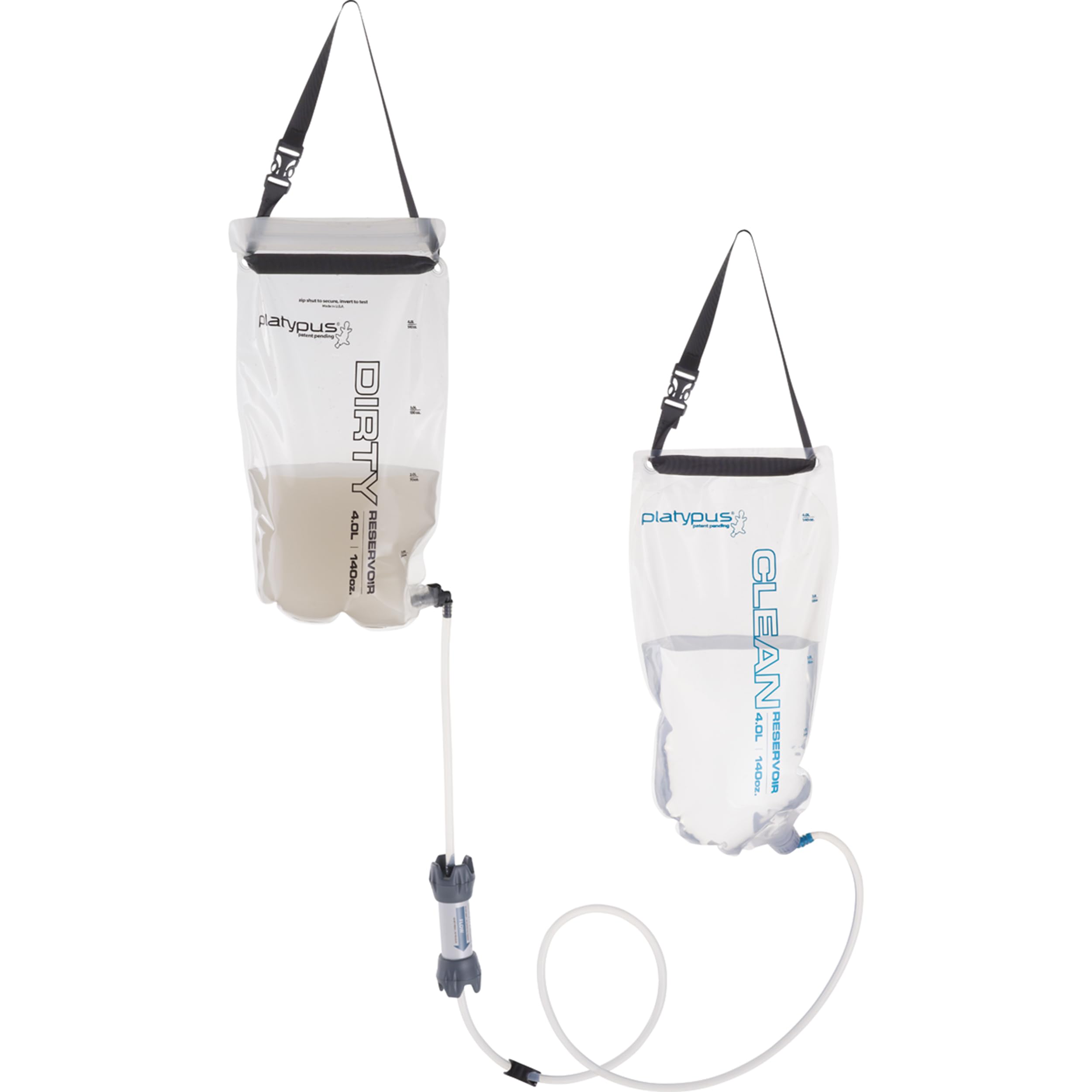
Platypus GravityWorks 4.0L
Two 4-liter bags and a fast hollow fiber filter: hang it, and 4 liters of filtered water are waiting a few minutes later.
- Holds
- 4 L plus 4 L clean
- Filter life
- Up to 1,500 L
- Flow
- 1.75 L a minute
- List price
- $134.95
No third-party certification found in the NSF, WQA or IAPMO listings. Flow, life and removal figures are Platypus's. List price and specs from cascadedesigns.com, checked 12 Nov 2026. Amazon’s price may differ.
A gravity bag does in camp what a countertop unit does at home. You fill the dirty bag at the lake, hang it from a branch and let the water run through the filter into a clean bag below. The GravityWorks is the one independent tests keep naming as the best for groups, and speed is the reason: Platypus rates it at 1.75 liters a minute, so a full 4-liter bag is through in a few minutes.
The second bag is its other strength. It stores what you filtered, so nobody is juggling bottles, and the dirty bag has a wide zip top that is quick to fill. Backflushing needs no syringe: you lift the clean bag above the dirty one and let water run back. Platypus also publishes a blow test: if air passes through the wet filter in a steady stream of bubbles, the fibers are broken and the cartridge must be replaced. (Platypus instructions)
Platypus rates the cartridge for about 1,500 liters and says it removes bacteria and protozoa, not viruses or chemicals. It must never freeze. Testers find the zip top hard to close and the bag hard to fill from shallow water.
- Platypus says it filters 1.75 liters a minute with no pumping
- A separate clean bag stores what it filters
- A blow test shows whether the filter is damaged
- No third-party certification found
- Must never freeze
- Does not remove viruses or chemicals
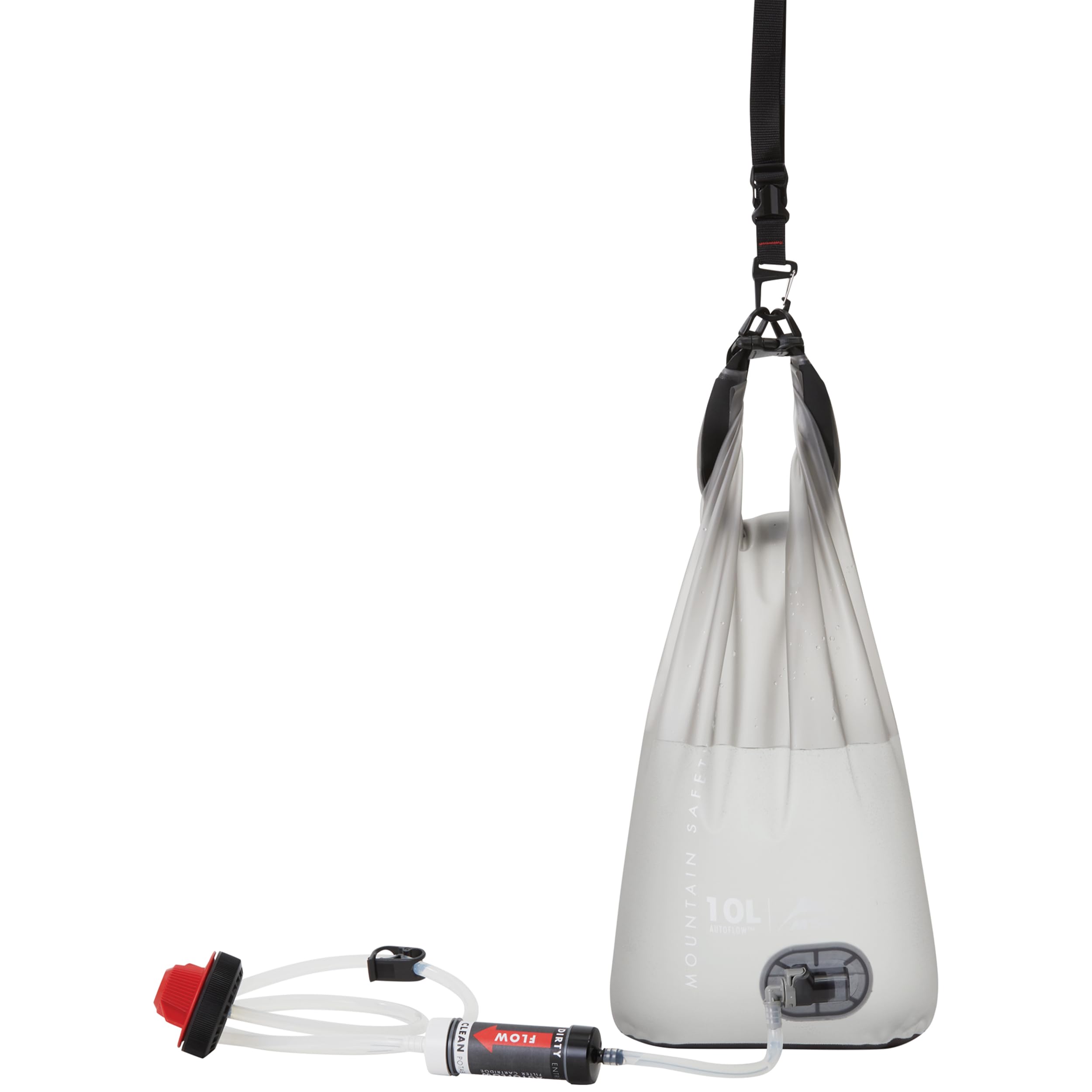
MSR AutoFlow XL 10 L
A 10-liter bag on a hollow fiber filter, for a base camp or a family that wants one fill to last the day.
- Holds
- 10 L
- Filter life
- Up to 1,500 L
- Flow
- 1.75 L a minute
- List price
- $139.95
No third-party certification found in the NSF, WQA or IAPMO listings. Removal, flow and life figures are MSR's. List price and specs from cascadedesigns.com, checked 12 Nov 2026. Amazon’s price may differ.
The AutoFlow XL is the biggest bag here. One 10-liter fill is a full day’s water for two people by MSR’s count, which makes it the gravity filter for a base camp, a family camping trip or a cabin without running water.
MSR says its hollow fiber filter meets NSF Protocol P231, the test protocol for microbiological purifiers, for bacteria (99.9999%) and protozoa (99.9%), from the start of the cartridge’s life to the end, in worst-case water. That is MSR’s own claim; we found the filter in no certifier’s listing. It has the same kind of blow test for damage as the Platypus, and a prefilter screen keeps larger debris out of the hose. (MSR instructions)
Know two things before you buy. It comes without a clean-water bag: you filter into your own pot or bottle, and you need a container of filtered water to backflush. In independent tests it was also the slowest of the gravity filters, and MSR asks for a backflush every 8 liters.
- One fill holds 10 liters, a day's water for two by MSR's count
- MSR says it meets NSF Protocol P231 for bacteria and protozoa
- Prefilter screen and a blow test for damage
- No third-party certification found
- No clean-water bag in the box
- Slowest of the gravity bags in independent tests

LifeStraw Peak Series Gravity Purifier 8 L
A gravity purifier: LifeStraw built its 0.02 micron ultrafilter to stop viruses as well as bacteria and parasites.
- Holds
- 8 L
- Filter life
- Up to 18,000 L
- Flow
- 30 L an hour
- List price
- $189.95
No third-party certification found in the NSF, WQA or IAPMO listings. Removal, flow and life figures are LifeStraw's. List price and specs from lifestraw.com, checked 12 Nov 2026. Amazon’s price may differ.
Every other filter here stops bacteria and protozoa and lets viruses through. The Peak Series Gravity Purifier is built to stop them too. Its ultrafilter has pores of 0.02 micron, and LifeStraw says it removes 99.99% of viruses such as rotavirus and hepatitis A, meeting the US EPA and NSF P231 standards for viruses, bacteria and parasites. We did not find it in a certifier’s listing, so that is LifeStraw’s claim.
That makes it the gravity system for travel where tap water is unsafe, for flood and storm kits, and for anyone who would otherwise filter and then disinfect. LifeStraw rates the membrane for 18,000 liters, which it calls about five years of water for a family of five.
The cost is speed. LifeStraw quotes 30 liters an hour, about a third of the Platypus’s rate, and REI buyers report slow flow and a long hose that needs a high hanging point. It was out of stock at LifeStraw when we checked on 12 Nov 2026. (REI product page)
- LifeStraw says it removes 99.99% of viruses
- Rated for 18,000 liters
- Tough 8-liter bag with a prefilter basket
- No third-party certification found
- Slow: LifeStraw says 30 liters an hour
- Hard to buy: out of stock at LifeStraw on 12 Nov 2026
What the filters cost to run
A gravity filter’s price tag is only the start. Their elements are rated for very different amounts of water, so we worked out what each costs per 100 gallons of rated life, from the list price of one replacement and the maker’s rating.
| System | Replacement and list price | Rated for | Per 100 gallons |
|---|---|---|---|
| Culligan MaxClear Scout | One MaxClear filter, $69.00 (Culligan) | 50 gal | $138.00 |
| British Berkefeld 12 L | One Ultra Sterasyl element, $42.00 (Lehman's) | 400 gal | $10.50 |
| Platypus GravityWorks | One replacement cartridge, $79.95 (REI) | 396 gal | $20.18 |
| MSR AutoFlow XL | One replacement cartridge, $76.95 (REI) | 396 gal | $19.42 |
| LifeStraw Gravity Purifier | One ultrafilter membrane, $84.95 (LifeStraw) | 4,755 gal | $1.79 |
Our arithmetic, not a measurement. Real life depends on the water and on cleaning. Culligan and British Berkefeld also set a six-month limit, so a household that uses little water replaces them on time rather than on volume. Replacement prices checked 12 Nov 2026.
The difference is large. A household drinking a gallon a day would need about seven MaxClear filters a year, and two sets of Berkefeld elements because of the six-month limit. The MaxClear’s certification for lead and PFAS is what that extra cost buys.
How big they are
Product photos rarely show scale, so we drew the systems next to a 12 oz drink can, using the dimensions each maker or retailer publishes. The bags are drawn full. Culligan publishes no outside dimensions for the Scout, so we drew its filter instead.
How a countertop gravity filter works
How to choose a gravity filter
If you are on city water
Decide what you want removed, then buy a system certified for it. Lead and PFAS fall under NSF/ANSI 53 and chlorine taste under 42. Of the systems we could buy today, only the MaxClear is listed for all of them. Your water supplier’s yearly quality report tells you what is in the supply. Lead often comes from the pipes inside older buildings, so your own tap can differ from the report.
If you want low running costs
Ceramic elements that can be scrubbed and reused last longest. The British Berkefeld’s are rated for 400 gallons each, against 50 for a MaxClear filter. You give up the lead and PFAS certification, so this is the choice when cost and taste matter more than those two.
If it is for camping, a cabin or an emergency kit
A countertop system expects safe tap water. For lake, river or rain water, use a camp gravity bag. The Platypus is the fastest and keeps clean water in its own bag; the MSR takes the most water per fill. If viruses are a risk, as they can be abroad or after a flood, the LifeStraw purifier is the only system here built for them, or you filter and then disinfect. (CDC)
What a gravity filter will not do
None of these systems softens hard water or removes salt, and none of the certifications we found covers fluoride or nitrate. The makers of the camp filters say they do not remove chemicals. The CDC adds that neither boiling nor disinfecting makes water safe when it holds harmful chemicals. (CDC)
Countertop system or camp gravity bag?
Both run on gravity and need no power, but they are built for different water.
| Type | Best for | Limits |
|---|---|---|
| Countertop system | Tap water at home: taste, and with the right certification, lead and PFAS. No plumbing, so renters can use one. | Slow, a few gallons a day. For water that is already safe. Takes counter space. |
| Camp gravity bag | Lake and river water for a group, a base camp or an emergency kit. Packs small. | Bacteria and protozoa only, unless it is a purifier. Must not freeze. Needs somewhere to hang. |
If you want a single person’s filter for hiking, see our water filter straws guide. For filtered tap water with less waiting, a certified under-sink filter fills a glass on demand.
Setting one up
- Wash the housing, not the filter. Both countertop makers say to wash the steel parts in warm soapy water before use. Culligan says to scrub the MaxClear filter with its sponge and water only. British Berkefeld says not to wash new ceramic elements at all. (Culligan; British Berkefeld)
- Tighten the wing nuts by hand. Over-tightening cracks elements and damages washers. Plug any unused holes with the stoppers supplied.
- Pour the first batches away. Culligan says to discard the first three fills of a new system. British Berkefeld says to run water to waste until it is clear and that full flow comes after two or three chambers.
- Use cold water and empty the bottom first. Both makers say cold water only, and Culligan says to empty the lower chamber before refilling the top so it cannot overflow.
- For a camp bag, hang it high and purge the air. Platypus and MSR both say to hang the dirty bag as high as the hoses allow and to clear air bubbles from the line by briefly lifting the clean side above the dirty side. (Platypus; MSR)
Cleaning and storage
Every filter here slows as it fills with what it has caught. These are the makers’ own instructions.
Culligan MaxClear
Clean the steel with dish soap or a half and half mix of white vinegar and water, rinse and air dry; it is not dishwasher safe. To clean a filter, hold it by its tan base and rinse the white ceramic under cool water for about two minutes while scrubbing with the sponge, with no soap and no water in the stem. Store filters somewhere cool and dry, and keep the system out of direct sun. (Culligan instructions)
British Berkefeld
When flow drops, take the elements out and scrub them evenly with a soft brush or a lightly abrasive pad, in a bowl of water or under the tap, keeping the plastic mount out of the water. Never use soap on the ceramic. Run a liter per element to waste after refitting. (British Berkefeld instructions)
Platypus, MSR and LifeStraw
Backflush often: Platypus before each use, MSR every 8 liters, LifeStraw after each use and whenever flow drops. Before long storage, Platypus and MSR say to run two drops of household bleach per liter of water through the system and dry it; LifeStraw gives half a teaspoon of bleach in a full bag. None may freeze. (Platypus; MSR; LifeStraw)
How we check
We research every product in depth before it goes on this page. That means reading the maker’s specifications and care instructions, searching the NSF, WQA and IAPMO certification listings, going through published results from independent field and lab tests, and reading what buyers report after using the product. We do not run a lab of our own, and we say so. More on how we check.
We list a product when we can state a specific reason for it. We leave a product out when we cannot confirm a claim it depends on. When a maker’s claim has no certification behind it, we say whose claim it is, and every price and spec carries the date we checked it.
We show a list price and not Amazon’s because Amazon only allows its prices on other sites through its own data feed. The button takes you to the live price.
Common questions
Why is Berkey not on this list?
Berkey was the best-known gravity filter for years, and many readers ask about it. In 2023 the US EPA issued stop-sale orders on Black Berkey filter products, ruling that their silver content and antimicrobial claims made them an unregistered pesticide device. Berkey now sells systems with a new element, the Phoenix Gravity New Millennium Edition. NSF lists Big, Royal and Travel Berkey systems with that element under NSF/ANSI 42 for chlorine and for taste and odor. We found no health-effects certification, such as NSF/ANSI 53 for lead, for any Berkey system, so we do not list it. (EPA order; NSF listing)
Do gravity filters remove viruses?
Most do not. The countertop systems and the Platypus and MSR bags are filters: the CDC says a filter with pores of 0.3 micron or smaller removes bacteria and parasites but not viruses. The LifeStraw Gravity Purifier is the exception here, by LifeStraw’s own testing. Where viruses are a risk and you have no purifier, the CDC advises filtering and then disinfecting. (CDC)
Can I pour stream, lake or well water into a countertop gravity filter?
Not untreated. Culligan says MaxClear systems are for potable water, and that water of unknown quality must be disinfected before or after. British Berkefeld’s instructions say the same. The Berkefeld’s cyst certification (on the 8.5-liter system) covers disinfected water that may still contain cysts. For untreated outdoor water, use one of the camp filters, and the purifier where viruses are possible. (Culligan instructions; British Berkefeld instructions)
Do gravity filters remove fluoride?
None of the certifications we found covers fluoride. Culligan makes no fluoride claim for MaxClear. British Berkefeld sells an Ultra Fluoride element, and NSF lists the 8.5-liter system that uses it for the same particulate, cyst and microplastics claims as the Ultra Sterasyl, not for fluoride. If fluoride is your concern, look at a certified reverse osmosis system. (NSF listing)
How long do the filters last?
Each maker sets its own rating: 50 gallons per MaxClear filter, 400 gallons per Ultra Sterasyl element, about 1,500 liters (396 gallons) for the Platypus and MSR cartridges and 18,000 liters for the LifeStraw membrane. Culligan and British Berkefeld also say to change their elements after six months, whichever comes first. Our running cost table above turns those figures into a cost per 100 gallons.
Can I put MaxClear filters in a Berkey or another steel system?
Culligan says they fit many systems, including Berkey, British Berkefeld and ProOne, if the system takes a 7-inch element mounted upright. The certification is a different matter: IAPMO lists the MaxClear filter in Culligan’s own Scout and Venture systems, so in another housing it is not covered. (Culligan; IAPMO listing)
I own a ProOne system. What now?
Culligan bought ProOne and is replacing its gravity line with MaxClear. Culligan says ProOne products are sold only while stock lasts and that MaxClear filters are made to fit ProOne systems such as the Big+ and the Traveler+. (Culligan and ProOne FAQs)
Why is the Waterdrop King Tank not on this list?
Its Amazon listing describes it as certified to NSF/ANSI 42 and 372. In the IAPMO directory on 12 Nov 2026 we found the King Tank (model TK-A) listed under NSF/ANSI 372 only, the standard for lead-free materials, and no listing for 42 or 53. We only list a certification we can confirm, so we have left it out until we can. (IAPMO directory)
Do I need to prime the filters?
It depends on the system. Culligan says MaxClear filters need no priming, though its instructions ask you to run three batches through a new system and pour them away. British Berkefeld says to run the first water to waste until it runs clear, and that full flow comes after two or three chambers as the ceramic soaks through. (Culligan instructions; British Berkefeld instructions)
What if a camp gravity filter freezes?
Platypus and MSR both say freezing permanently damages the hollow fibers, and LifeStraw says to keep its purifier above 32°F. Platypus and MSR give a blow test to check for damage; if in doubt, replace the cartridge. In cold weather keep the filter in a pocket or sleeping bag. (Platypus instructions; MSR instructions; LifeStraw)
Can I use a gravity filter during a boil water notice?
Follow your health department first. The CDC calls boiling the best way to kill germs: one minute at a rolling boil, three minutes above 6,500 feet. If you cannot boil, it advises filtering and then adding a disinfectant. No filter here makes water safe if it holds fuel or toxic chemicals, which is common in flood water. (CDC)
Sources
Makers, certifiers, public bodies and retailers’ specification pages, all read on 12 Nov 2026. Dates after a title are the page’s own.
- IAPMO R&T, listing W-17177, Culligan MaxClear, NSF/ANSI 53 (lead, total PFAS)
- IAPMO R&T, listing W-17176, Culligan MaxClear, NSF/ANSI 42 (chlorine, chloramine, particulate)
- IAPMO R&T, listing W-17178, Culligan MaxClear, NSF/ANSI 401 (microplastics and seven trace chemicals)
- Culligan, Scout 2.25 gallon gravity system product page
- Culligan, MaxClear performance data sheet
- Culligan, MaxClear gravity system installation and operating instructions
- Culligan, MaxClear replacement filter product page
- Culligan, Culligan and ProOne FAQs
- NSF, listing for British Berkefeld (Doulton Water Filters)
- British Berkefeld, SS2 Ultra Sterasyl 8.5 L system instructions and performance data
- Lehman's, British Berkefeld 3.17 gallon gravity water filter product page
- Lehman's, British Berkefeld Ultra Sterasyl ceramic filter product page
- Platypus (Cascade Designs), GravityWorks water filter system product page
- Platypus, GravityWorks instructions, document 33-277-4 (retailer copy)
- REI, Platypus GravityWorks Water Filter System 4 L product page
- REI, Platypus GravityWorks/CleanStream replacement cartridge product page
- MSR (Cascade Designs), AutoFlow XL Gravity Filter 10 L product page
- MSR, AutoFlow XL instructions
- REI, MSR AutoFlow XL Gravity Filter 10 L product page
- REI, MSR AutoFlow replacement filter cartridge product page
- LifeStraw, Peak Series Gravity Purifier product page
- LifeStraw help center, Cleaning and maintaining your Peak Series Gravity Purifier
- LifeStraw help center, How to store your Peak Series Gravity Purifier
- REI, LifeStraw Peak Series Gravity Purifier 8 L product page
- CDC, Water treatment options when hiking, camping, or traveling, reviewed 30 Jan 2025
- CDC, How to make water safe in an emergency, 19 Sep 2024
- NSF, listing for Berkey (New Millennium Concepts)
- US EPA, Stop Sale, Use, or Removal Order on Black Berkey filter products, docket FIFRA-08-2023-0015, 2023
- NSF, certified drinking water treatment units listing
- WQA, certified product listings
- IAPMO R&T, product listing directory